Cold craft
Batteries, Condensation, and the Three Winter Failures
Cold does not usually break a camera. It drains it, fogs it, and makes it impossible to operate, and each of those has a plain fix that costs almost nothing.
April 28, 2026 / Learned the hard way / Any cold month / 8 min read
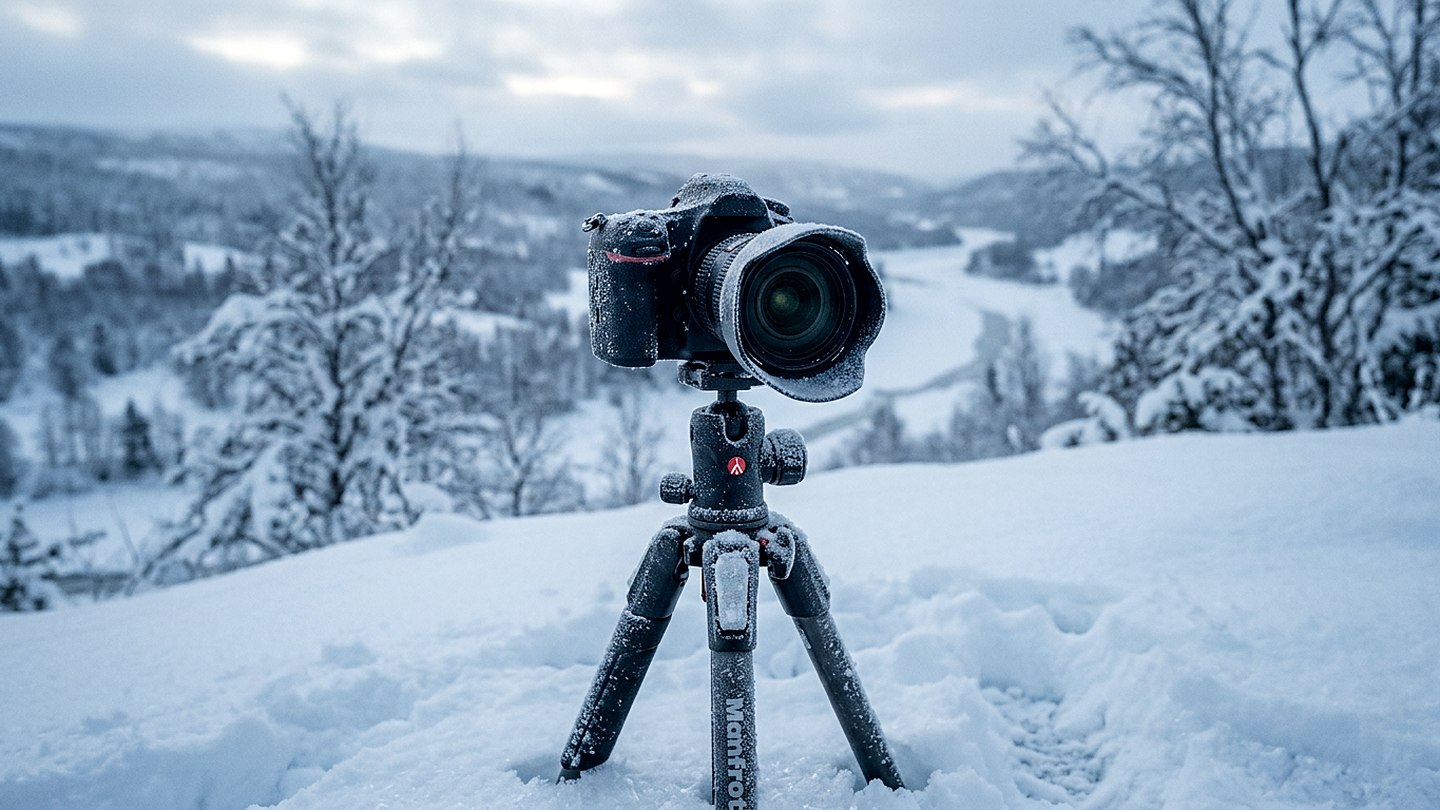
Cameras are tougher in the cold than people expect. In eight winters of working in this region, including several days below minus fifteen, I have not had a body or a lens fail from cold itself.
What I have had, repeatedly, is the three practical failures underneath: power disappearing far faster than the indicator suggests, glass and sensors fogging at the worst possible moment, and controls becoming unusable because of what is on my hands. All three are entirely preventable and none of the fixes are expensive.
This is the routine that removed them.
01One: power, which is a chemistry problem
A lithium battery in the cold does not lose its charge. Its ability to deliver current drops, which reads on the camera as a battery that was three quarters full a minute ago and is now dead.
Two things follow from that. The first is that a cold battery is not finished. Put it in an inside pocket for twenty minutes and a large part of that indicated capacity comes back, and it will run the camera again. I rotate two or three batteries through a session on that basis and none of them ever reaches the end of its actual charge in the field.
The second is that the meter should be ignored below about minus ten. It is reporting voltage under load in conditions the calibration never anticipated. Work on time elapsed instead, and swap on a schedule rather than on a warning.
At minus twelve I plan for roughly a third of the frames per battery that I would get indoors. That number has been consistent enough that I now pack accordingly.
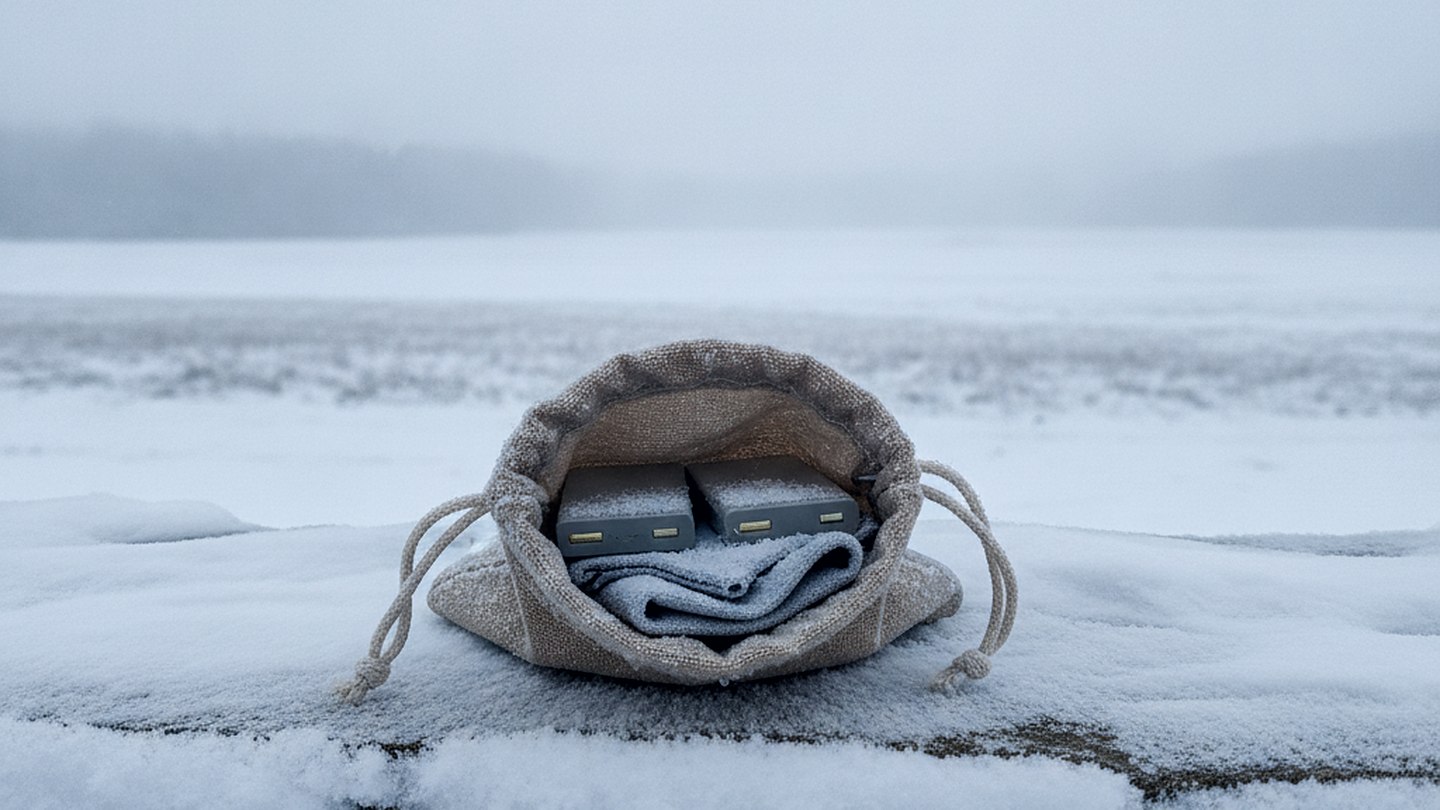
Spares go in a pocket inside the insulation layer, against the body, never in the bag. A spare battery in a bag at ambient temperature is not a spare, it is a second dead battery you are carrying.
The dangerous moment is not the four hours outside at minus twelve. It is the ninety seconds after you walk through a warm door with the bag open.
02Two: condensation, which happens indoors
This is the one that surprises people and it is the only failure on this list that can genuinely damage equipment.
Cold air holds very little moisture. Warm indoor air holds a great deal. Bring a piece of metal and glass at minus twelve into a room at plus twenty and the moisture in that room condenses onto and, worse, inside it, in a matter of seconds. Do it repeatedly and you eventually get corrosion, fungus, or an electronic fault.
The fix costs nothing. Before going indoors, close the bag and seal it, and leave it closed for two or three hours until the contents have come up to room temperature inside their own little envelope of cold dry air. The condensation then forms on the outside of the bag, where it does not matter, and the camera stays dry.
Never open the bag to check something the moment you get in. That single impulse is the whole of the problem. If I need a card in a hurry, I take the card out while still outside and leave everything else sealed.
The same logic applies at the other end. Going from warm to cold is harmless, and a camera that starts cold stays clear. Which is why the bag lives in the boot of the car overnight rather than in a heated room, and why I do not warm up equipment during a shooting day.
03Three: operating the thing at all
Most of my ruined winter frames were not ruined by cold. They were ruined by fingers.
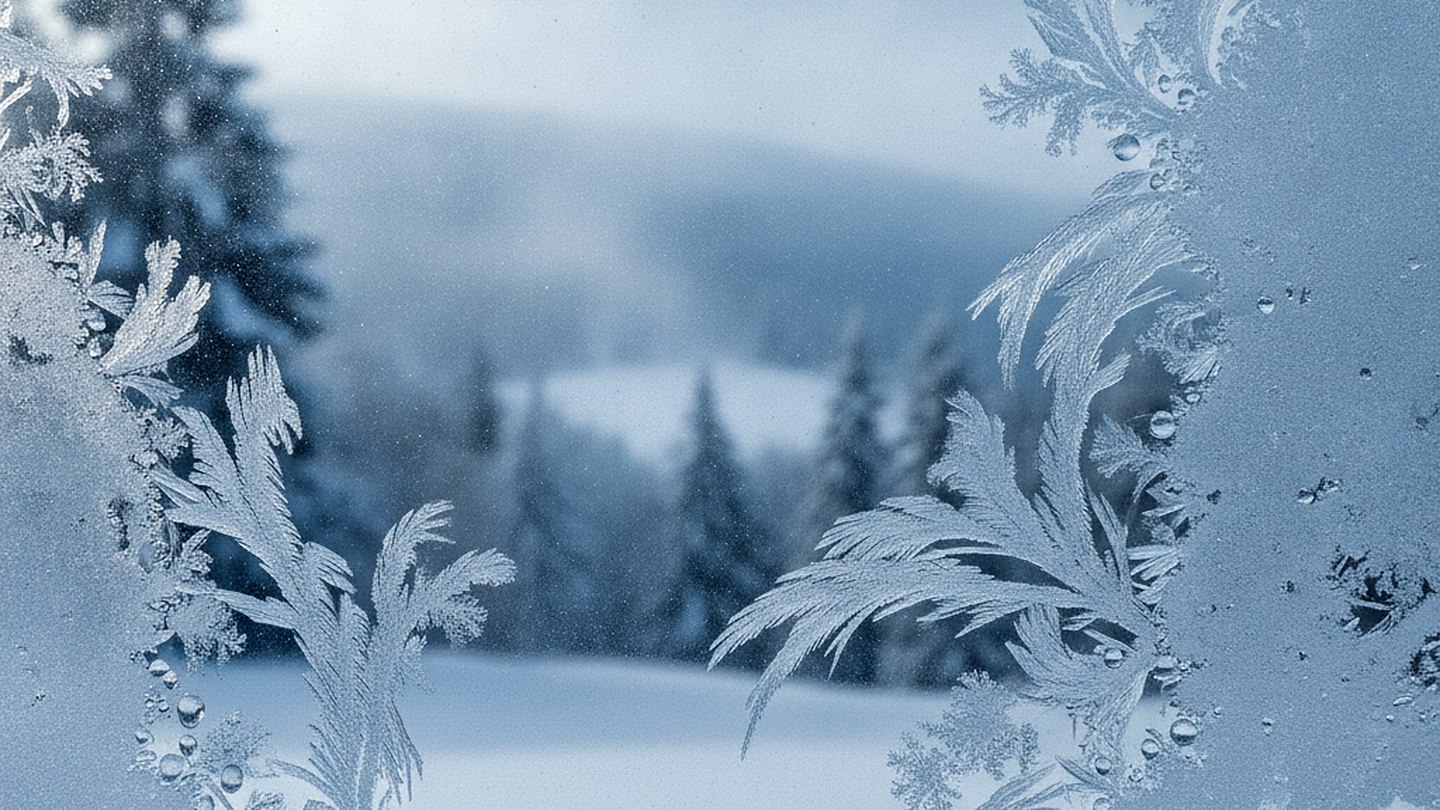
The viewfinder is the first casualty. Breathe near an eyepiece at minus ten and it frosts instantly, and it will not clear by wiping. Working at arm's length with the rear screen avoids that entirely, which is not how I like to work but is what the conditions allow. Turning your head to breathe away from the camera sounds ridiculous and helps enormously.
The front element is the second. Snow landing on it is not a problem while it stays frozen, and a soft brush removes it. The problem is a warm hand or a breath near it, which melts something that then refreezes into a smear that no cloth will shift in the field. A deep hood and a cap between frames handle most of this.
The third is the controls themselves. A thin liner glove that never comes off, plus overmitts, is what I use, and the notes on that live in the companion report on this site. What matters here is planning the sequence: settings set before the gloves matter, tripod adjusted before the hands get cold, and as few button presses as the shot allows.
04The small kit that earns its place
Two spare batteries, inside pocket.
A soft brush and one dry microfibre cloth, in an outer pocket. A cloth that lives in the bag with a damp one is a damp cloth.
Cards changed outdoors, not indoors, in the sealed bag routine.
A large plastic bag that the camera bag itself goes into if the bag is not sealable. Cheap, and it is what makes the condensation routine work with any bag at all.
Nothing heated, nothing exotic, and no cold weather grease or servicing. Modern gear handles the temperatures found in the eastern snow belt without any of that.
05What about snow actually falling on it
Fine, within reason, and better than rain by a wide margin because it is dry.
Falling snow at minus eight sits on a camera and can be brushed off. The risk arrives when the camera is warm enough for it to melt, which happens either indoors or during a long session in mild conditions around zero. Around freezing point I cover the body between frames. At minus ten I mostly do not bother.
Blowing snow in a strong wind is different, since it drives into every seam. That is the one condition in which I put the whole thing away and go back to the car, which is also the condition in which nothing useful is visible anyway.
06The routine, in order
Bag stored cold, in the car overnight. Batteries warm, in an inside pocket. Settings made before the hands are cold. Brush and cloth accessible without opening the main compartment. Battery swapped by the clock. Card out while still outside. Bag sealed before the door. Bag opened three hours later.
It is a short list and it has held up through everything the eastern lakes have produced in eight winters, including a week where the daytime high did not reach minus ten.